The question “How much does Laravel development cost?” is almost always the first one asked by business owners and startup founders. It’s a smart question. In 2026, with global economic fluctuations and a crowded digital market, understanding your investment in a Laravel web application is critical for ROI.
However, providing a single number is nearly impossible. Laravel is too versatile. A simple company blog will cost a fraction of a complex, AI-driven SaaS platform.
This comprehensive guide breaks down everything you need to know about Laravel development pricing in 2026. We’ll cover hourly rates by region, total project costs by complexity, hidden fees, and strategies to optimize your Laravel project cost without sacrificing quality.
The Average Cost of Laravel Development in 2026
To give you a ballpark figure, the cost of Laravel development is typically calculated by multiplying the development hours by the developer’s hourly rate. Based on current market data from Q1 2026, here is the landscape:
- Hourly Rates: Generally range from $30 to $150+ per hour, heavily dependent on the developer’s geographic location and seniority.
- Total Project Cost: Depending on complexity, a custom Laravel application can range from $15,000 for a basic tool to over $200,000 for an enterprise-grade solution.
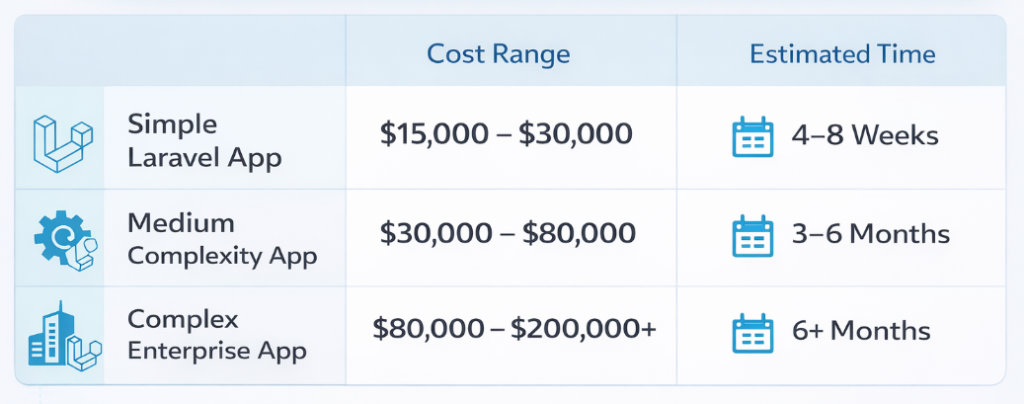
Let’s visualize these costs by project type.
Laravel Project Cost by Complexity
The primary driver of cost is complexity. Here is a breakdown of what you can expect to pay for different types of Laravel projects in 2026:
| Project Complexity | Typical Cost Range (USD) | Examples & Features | Timeline Estimate |
| Simple Laravel App | $15,000 – $30,000 | • Corporate site • Basic CRUD • Admin panel • Portfolio site | 4-8 Weeks |
| Medium Complexity App | $30,000 – $80,000 | • SaaS MVP • E-commerce • CRM tools • API integrations | 3-6 Months |
| Complex Enterprise App | $80,000 – $200,000+ | • Multi-tenant SaaS • ERP systems • AI integration • Marketplaces | 6+ Months |
Laravel Developer Hourly Rates: A 2026 Global Comparison
Where you hire from significantly impacts your cost to build a Laravel app. A senior developer in San Francisco commands a different rate than one in Ho Chi Minh City. However, rate is not the only indicator of quality; experience and communication matter most.
Here is a look at average Laravel development hourly rates by region for 2026:
| Region | Junior Developer ($/hr) | Mid-Level ($/hr) | Senior Developer ($/hr) |
| United States & Canada | $40 – $70 | $70 – $100 | $100 – $150+ |
| Western Europe | $30 – $50 | $50 – $80 | $80 – $120 |
| United Kingdom | $35 – $55 | $55 – $85 | $85 – $130 (approx. £70-£100+) |
| Australia | $40 – $60 | $65 – $95 | $95 – $140+ |
| Eastern Europe | $20 – $35 | $35 – $60 | $60 – $90 |
| Latin America | $15 – $25 | $25 – $45 | $45 – $70 |
| India | $10 – $20 | $20 – $35 | $35 – $50 |
| Southeast Asia | $10 – $18 | $18 – $30 | $30 – $45 |
Note on Extremes: You may see ads for rates as low as $9/hour. While tempting, these rates often entail significant trade-offs in communication, code quality, security practices, and project management, leading to higher costs down the line due to technical debt or rework.
Key Factors Influencing Laravel Development Pricing
Beyond the hourly rate, several variables will affect your final invoice. Understanding these helps you control the Laravel project cost effectively.
- Features & Complexity: This is the biggest factor. A simple contact form costs nothing to build, but a custom video upload feature with transcoding requires significant backend logic and server resources.
- Third-Party Integrations: Do you need to connect to Stripe, PayPal, Salesforce, or shipping APIs like Shippo? Each integration requires development time to handle authentication, data mapping, and error logging.
- UI/UX Design Complexity: A basic Bootstrap template is cheap. A custom, pixel-perfect design with complex animations, micro-interactions, and a thorough user experience research phase will add to the budget.
- Developer’s Experience: A senior developer costs more per hour but writes cleaner, more secure, and more scalable code faster than a junior developer. This often results in a lower total project cost and fewer bugs post-launch.
- Project Timeline: If you need your project rushed from 6 months to 3, you will likely pay a premium for the dedicated resources and overtime required to meet that deadline.
Laravel vs. Other Technologies: A Cost Comparison
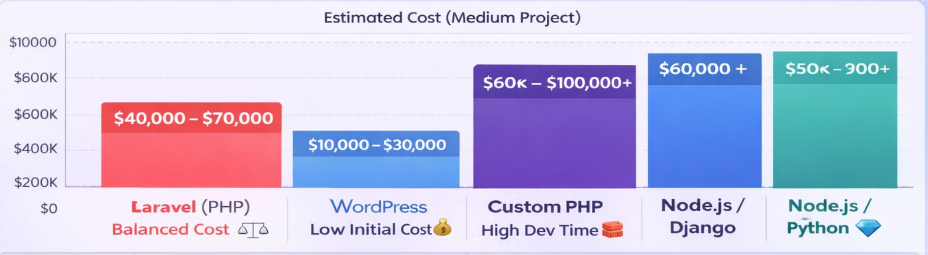
Why choose Laravel? It often hits a “sweet spot” between development speed and cost. Here’s how it compares to other popular options for building a standard business web app :
| Technology | Estimated Budget (USD) | Development Speed | Scalability | Maintenance Cost | Suitable For |
|---|---|---|---|---|---|
| Laravel (PHP) | 40,000 – 70,000 | High | High | Moderate | Structured business applications |
| WordPress | 10,000 – 30,000 | Very High | Limited | Variable (often increases) | Content-driven websites |
| Custom PHP (Core) | 60,000 – 100,000+ | Low | Very High | High | Fully customized systems |
| Node.js / Django | 50,000 – 90,000+ | Medium | Very High | Moderate–High | Real-time or data-intensive platforms |
Cost Breakdown by Service Type
Are you building a specific type of application? Here’s a look at the typical Laravel development cost for common service categories.
Custom Web Application: The most common type. Costs align with the complexity chart above. A custom portal for employees might cost $35,000, while a complex lead management system could hit $80,000.
SaaS Development: Building a Software-as-a-Service product involves multi-tenancy (separate databases for each customer), subscription billing logic, and robust scaling. Cost Range: $50,000 – $150,000+.
API Development: If you need to build a headless backend or a mobile app API, Laravel (especially with Laravel Sanctum or Passport) is excellent. An API-only project is usually less expensive due to the lack of a frontend UI. Cost Range: $15,000 – $40,000.
E-commerce Development: Laravel e-commerce packages (like Bagisto or Aimeos) offer more flexibility than WooCommerce but require more development know-how. A custom Laravel e-commerce store typically starts at $30,000.
The Hidden Costs of Laravel Projects
Your development budget isn’t the final number. Smart budgeting requires accounting for these often-overlooked Laravel software charges:
- Hosting & Infrastructure: A simple site can run on shared hosting for a few dollars, but a business app needs robust hosting. Expect to pay $50 – $500+ per month for cloud hosting (AWS, DigitalOcean, Laravel Forge), depending on traffic and server resources.
- Domain & SSL: Budget $10 – $50/year for a domain name and $0 – $150/year for SSL certificates (many hosting plans now include free SSL via Let’s Encrypt).
- Third-Party Services: These are ongoing operational costs. Examples include monthly fees for payment gateways (Stripe: 2.9% + $0.30/transaction), email marketing tools (Mailchimp), SMS APIs (Twilio), and monitoring tools.
- Maintenance & Support: Software needs love after it’s built. This includes bug fixes, security patches (especially critical for PHP/Laravel), and minor feature updates. Most agencies charge a monthly retainer of 15-20% of the initial development cost per year. For a $50,000 app, that’s $7,500 – $10,000 annually.
- DevOps & Security: For larger projects, costs for automated deployment pipelines, load balancing, and security audits (penetration testing) should be factored in.
How to Reduce Laravel Development Costs
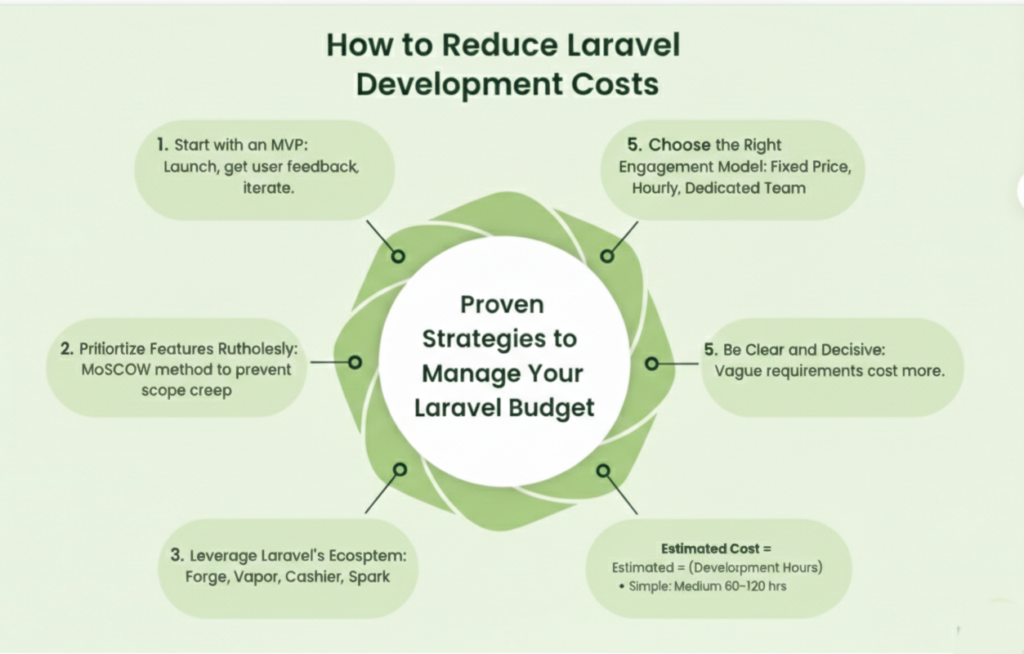
You don’t need to break the bank to get a great application. Here are proven strategies to manage your Laravel budget:
- Start with an MVP: Don’t build the “dream app” with every feature on day one. Define the core problem you need to solve and build a Minimum Viable Product (MVP). Launch it, get user feedback, and then iterate. This is the most effective way to manage risk and cost.
- Prioritize Features Ruthlessly: Use a MoSCoW method (Must have, Should have, Could have, Won’t have). This gives the development team a clear hierarchy and prevents “scope creep.”
- Leverage Laravel’s Ecosystem: Laravel has incredible first-party tools like Laravel Forge (server management), Vapor (serverless deployment), Cashier (subscription billing), and Spark (SaaS boilerplate). Using these saves thousands of development hours.
- Choose the Right Engagement Model:
- Fixed Price: Best for small, well-defined projects with minimal changes.
- Hourly / Time & Materials: Best for larger projects where requirements may evolve. You pay for the actual time spent, offering flexibility.
- Dedicated Team: Best for long-term projects or startups needing continuous development. You pay a fixed monthly rate for a developer or team.
- Be Clear and Decisive: Vague requirements lead to billable hours spent on discovery and rework. The clearer you are about what you want, the more efficiently a developer can build it.
Interactive Element: Calculate Your Project Cost
Want a rough estimate right now? Use this simple formula:
Estimated Cost = (Estimated Development Hours) x (Average Hourly Rate)
- Simple Project: 400-600 hours
- Medium Project: 600-1,200 hours
- Complex Project: 1,200+ hours
Multiply these hours by the rate in your preferred region from the table above to get your estimate.
Real-World Laravel Project Examples (Binary Fusion Portfolio)
Theory is helpful, but real examples provide clarity. Here are anonymized examples of past projects from our team to illustrate Laravel project costs:
- Example 1: The Lean Startup (FinTech MVP)
- Project: A platform for freelancers to send automated invoice reminders.
- Complexity: Medium. Integrated with Stripe, Gmail API, and Plaid for bank connectivity.
- Team: 1 Senior Developer, 1 Part-time UI Designer.
- Timeline: 4 Months.
- Cost: $55,000
- Example 2: The Enterprise Solution (Logistics Platform)
- Project: A custom dashboard for a trucking company to manage routes, fuel efficiency, and driver hours (ELD compliance).
- Complexity: High. Real-time GPS tracking, a complex algorithm for route optimization, and offline functionality for mobile units.
- Team: 2 Senior Developers, 1 Project Manager, 1 QA Engineer.
- Timeline: 9 Months.
- Cost: $185,000
- Example 3: The Small Business Upgrade (E-commerce)
- Project: Migration from Magento to a custom Laravel e-commerce store for a boutique furniture maker.
- Complexity: Medium. Required custom product configurator (choose wood/fabric) and quick order form for wholesalers.
- Team: 1 Full-Stack Developer, 1 Designer.
- Timeline: 3.5 Months.
- Cost: $42,000
Why Choose Binary Fusion for Your Laravel Project?
At Binary Fusion, we believe in transparent pricing and value-driven development. We don’t just write code; we partner with you to ensure your investment drives real business results.
- Whether you prefer a fixed-price quote for a clear scope or a dedicated team for ongoing growth, we provide clear contracts with no hidden fees.
- During our discovery phase, we help you analyze which features provide the highest ROI and which can be simplified or postponed, ensuring your Laravel budget is spent wisely.
- You get the cost benefits of a global talent model combined with the communication and quality assurance of US-based leadership.
- From the first line of code to long-term maintenance and scaling, we are your long-term technology partner.
Conclusion
Determining the Laravel development cost in 2026 involves more than just asking for a price. It requires understanding your own needs, the global talent market, and the long-term value of a well-architected application. Whether your project is a simple $15,000 website or a $200,000 enterprise platform, Laravel remains one of the most cost-effective, secure, and scalable frameworks available today.

![Flutter UI Design: Create Beautiful Mobile App Interfaces [2026]](https://blog.binary-fusion.com/wp-content/uploads/2026/02/featured-flutter-ui-design-guide-1.png)
![Laravel + React: The Complete Guide for Business Owners and Beginners [2026]](https://blog.binary-fusion.com/wp-content/uploads/2026/02/Gemini_Generated_Image_665qn8665qn8665q.png)