In 2026, Laravel development services still lead web development, helping startups, SaaS companies, and enterprises build secure, scalable apps. Businesses increasingly hire professional Laravel development companies to accelerate digital transformation and reduce time-to-market.
What Is Laravel? Understanding the Framework Behind Modern Web Apps
Custom Laravel development services have become the go-to solution for businesses building modern, enterprise-grade web applications with long-term scalability in mind. Laravel is an open-source PHP framework that has transformed how developers build modern web applications. Created by Taylor Otwell in 2011, Laravel appeared as a response to more complex PHP development. It offered a cleaner, more expressive syntax that made common web tasks simpler and more enjoyable.
At its core, Laravel is built on the Model-View-Controller (MVC) architectural pattern, which provides a structured approach to organizing code by separating business logic from presentation layers. This separation ensures that applications remain maintainable, scalable, and testable as they grow in complexity. What sets Laravel apart from other PHP frameworks is its philosophy of putting developer experience first. Every feature, from routing to database migrations, is designed with clarity and ease of use in mind.
The Laravel Framework Explained
PHP Foundation: Laravel is compatible with most hosting environments, making Laravel web development services cost-effective and easy to deploy.
MVC Architecture: A clean separation of logic, UI, and input handling ensures maintainable and scalable Laravel application development.
Routing System: Provides a structured and efficient syntax for defining RESTful API endpoints and application routes.
Dependency Injection: IoC container for modular and testable code.
Why Businesses Choose Laravel in 2026
The decision to invest in a technology stack is a business decision first. Here’s why Laravel remains a top contender in 2026:
- Rapid Time-to-Market with Professional Laravel Development Services
Built-in features (authentication, sessions, routing) drastically reduce development time, allowing you to launch MVPs and full-scale products faster. - Cost-Effectiveness
Faster development translates directly to lower initial development costs. The large pool of Laravel developers also keeps hiring rates competitive. - Scalability for Growth
With tools like Laravel Octane (which boosts performance using application servers like RoadRunner and Swoole) and built-in support for popular caching systems, Laravel applications can scale to handle millions of users. - Robust Security
Laravel protects against common web vulnerabilities like SQL injection, cross-site request forgery, and cross-site scripting (XSS) right out of the box, reducing the risk of costly security breaches. - Thriving Ecosystem
Laravel isn’t just a framework; it’s a platform with tools like Forge (server management), Vapor (serverless deployment on AWS), and Nova (admin panel), providing a complete development and deployment ecosystem. - Strong Community Support
A massive, active community means a wealth of tutorials, packages, and solutions are readily available, ensuring you’re never stuck with a problem for long.
Top 10 Advantages of Laravel Development Services for Business Applications
When evaluating technology choices for business applications, understanding the specific advantages a framework offers is essential. Laravel delivers numerous benefits that directly impact business outcomes:
- Elegant Syntax and Developer Productivity: Laravel’s expressive, readable syntax reduces the cognitive load on developers, allowing them to write cleaner code faster. Features like method chaining, eloquent routing, and blade templating make complex operations feel intuitive. For businesses, this means faster development cycles and code that’s easier to review, debug, and maintain over time.
- Comprehensive Eloquent ORM database interactions are fundamental to most business applications, and Laravel’s Eloquent ORM transforms what could be tedious SQL writing into elegant, object-oriented code. Relationships between data models are defined through simple method calls, and complex queries can be constructed through a fluent interface that reads almost like natural language.
- Built-in Authentication and Authorization. Every business application needs to control who can access what, and Laravel makes implementing these security controls straightforward. The framework provides a complete authentication system out of the box, including user registration, login, password reset, and email verification. Beyond basic authentication, Laravel’s authorization features through Gates and Policies allow fine-grained control over user permissions.
- Robust Testing Infrastructure. Features like testing database transactions, HTTP testing, and browser testing through Laravel Dusk ensure that applications work correctly before they reach production. This testing culture reduces the cost of bugs and provides confidence when making changes to existing code.
- Powerful Queue and Job System. Modern business applications often need to perform time-consuming operations, such as sending emails, processing images, and generating reports, without making users wait. Laravel’s queue system provides a unified API for deferring these tasks to background workers, with support for multiple queue backends including Redis, Amazon SQS, and database-driven queues. This architecture ensures responsive user experiences while efficiently utilizing server resources.
- Database Migration and SeedingLaravel’s migration system provides version control for databases, allowing schema changes to be tracked in code and applied consistently across environments. Combined with database seeding for test data, this ensures that development environments match production and that database changes can be reviewed like any other code change.
- Rich Package Ecosystem: The Laravel ecosystem includes thousands of packages that extend the framework’s capabilities. This ecosystem means businesses don’t need to reinvent the wheel for standard functionality, and the community-driven nature of these packages ensures they stay updated with the latest best practices.
- Real-time Capabilities with Laravel EchoModern business applications increasingly require real-time features, live dashboards, instant notifications, and collaborative editing. Laravel Echo, combined with broadcasting capabilities, makes implementing these features straightforward. This real-time infrastructure enables applications that feel responsive and modern without the complexity typically associated with WebSocket implementations.
- API Development Excellence. As businesses move toward API-first architectures and microservices, Laravel’s API development capabilities have become increasingly valuable. The framework provides API resource classes for transforming data, built-in API authentication through Laravel Sanctum and Laravel Passport, and automatic API documentation generation.
- Deployment and DevOps Integration: Laravel Forge provides server management and deployment automation, while Laravel Vapor offers serverless deployment on AWS. These tools integrate seamlessly with the framework, providing zero-downtime deployments, SSL certificate management, and database backups with minimal configuration. For businesses, this means reduced operational overhead and more reliable deployment processes.
Types of Applications You Can Build with Laravel
Laravel’s versatility extends across virtually every category of web application. Its combination of rapid development capabilities and enterprise-grade features makes it suitable for a wide range of use cases:
Enterprise Resource Planning (ERP) Systems
Large organizations use Laravel to build custom ERP solutions that integrate with their specific business processes. Laravel’s security features and audit trail capabilities are particularly valuable in ERP contexts where data integrity and compliance are paramount.
Customer Relationship Management (CRM)
Custom CRM solutions built on Laravel allow businesses to match their sales and customer service processes exactly, rather than adapting to generic CRM platforms. Businesses with complex sales workflows or industry-specific requirements often find that a Laravel-based CRM provides capabilities that off-the-shelf solutions cannot match.
Learning Management Systems (LMS)
The framework’s support for multimedia content, progress tracking, and assessment systems provides the foundation for sophisticated LMS applications. Features like real-time collaboration, video streaming integration, and certification management are readily implemented, while the ability to integrate with existing student information systems or HR platforms ensures seamless data flow.
Custom Web Application Development
Building bespoke, scalable web applications tailored to specific business requirements using Laravel’s MVC architecture.
Healthcare Applications
Laravel’s security features and HIPAA compliance capabilities make it suitable for healthcare applications. The framework’s audit logging, encryption features, and access control systems address the stringent security requirements of healthcare data.
Financial and Banking Applications
The framework’s transaction support, logging capabilities, and integration with financial APIs make it suitable for applications ranging from personal finance tools to complex trading platforms. Laravel’s testing infrastructure is particularly valuable in financial contexts where correctness is non-negotiable.
Real-time Applications
From live chat applications to collaborative document editors, Laravel’s real-time capabilities support applications requiring instant data synchronization. The combination of Laravel Echo, broadcasting, and queue systems enables applications that feel responsive and connected.
Laravel vs Other Technologies: Is It the Right Choice for Your Project?
Before choosing Laravel, many businesses compare it with Node.js and Django. Here’s a practical comparison.
| Feature | Laravel (PHP) | Node.js (JavaScript) | Django (Python) |
| Language | PHP (easy to host, widely used) | JavaScript (full-stack JS) | Python (data-science friendly) |
| Best For | Full-featured web apps, SaaS platforms, enterprise Laravel solutions, and custom e-commerce development | Real-time apps, APIs, high I/O | Data-heavy apps, rapid prototyping |
| Learning Curve | Moderate (easy for PHP devs) | Moderate (requires async understanding) | Easy (very readable) |
| Performance | Good (excellent with Octane) | Excellent for I/O, can be complex for CPU | Good |
| Ecosystem | Mature, PHP-centric | Massive NPM ecosystem | Mature, Python-centric |
Laravel + Modern Frontend Stack: React, Vue, Next.js & Livewire
Modern development is full-stack. Here is how Laravel pairs with today’s frontend giants:
| Stack | Best For | Example Use Case |
|---|---|---|
| Laravel + React | Dynamic SPAs with complex state | Dashboard with real-time analytics |
| Laravel + Vue.js | Lightweight, progressive enhancement | Admin panels |
| Laravel + Next.js | SEO-friendly hybrid apps | Marketing site with blog |
| Laravel + Livewire | Server-rendered interactivity | Form-heavy applications |
What Does a Typical Laravel Development Process Look Like?
- Discovery & Planning: We define project goals, target audience, core features, and technical requirements. This includes creating a project roadmap and choosing the right frontend stack.
- UI/UX Design: Designers create wireframes and high-fidelity mockups of the application, focusing on user experience and brand alignment.
- Architecture & Database Design: Architects set up the Laravel environment, design the database schema using migrations, and establish the core application structure.
- Development (Backend & Frontend):
- Backend: Developers build the business logic, create API endpoints, set up authentication, and integrate third-party services.
- Frontend: Developers implement the UI based on designs, connecting it to the backend via APIs or Livewire components.
- Testing & Quality Assurance: Rigorous testing is performed, including unit tests, feature tests, and manual QA to ensure the application is stable, secure, and bug-free.
- Deployment: The application is deployed to a production server, often using Laravel Forge or Vapor for streamlined management.
- Launch & Post-Launch Support: The application goes live, followed by monitoring, maintenance, and iterative improvements based on user feedback.
Laravel Development Best Practices for Performance & Security
- Use Caching: Implement Redis or Memcached for caching database queries, views, and routes.
- Optimize Queues: Offload email sending, image processing, and other heavy tasks to queues.
- Laravel Octane: For high-traffic apps, use Octane to dramatically boost performance.
- Asset Optimization: Minify CSS/JavaScript and use a CDN for serving static assets.
- Database Indexing: Ensure your database tables are properly indexed for fast queries.
- Keep Laravel Updated: Always use the latest stable version to benefit from security patches.
- Environment Security: Never expose your .env file. Keep sensitive keys out of version control.
- Use Prepared Statements: Eloquent ORM inherently protects against SQL injection.
- Validate Input: Always validate and sanitize user input using Laravel’s validation rules.
- CSRF Protection: The built-in CSRF middleware is enabled by default.
How Much Does Laravel Development Cost in 2026?
Typical Cost Ranges
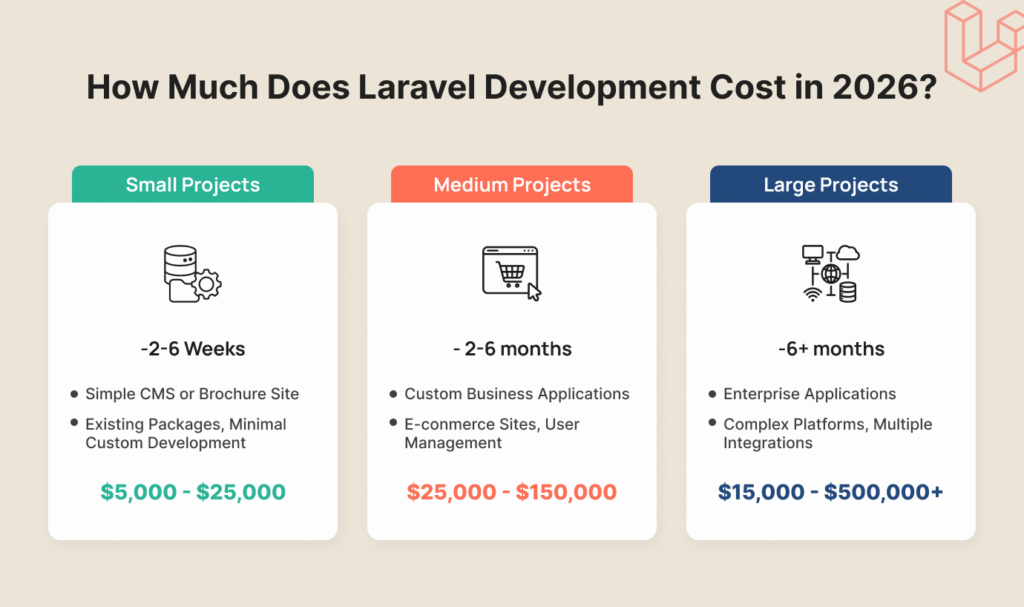
Small Projects (2-6 weeks, simple CMS or brochure site): $5,000 – $25,000. These projects typically use existing packages for most functionality with minimal custom development.
Medium Projects (2-6 months, custom business applications, e-commerce sites): $25,000 – $150,000. This range covers most business applications with custom features, user management, and third-party integrations.
Large Projects (6+ months, enterprise applications, complex platforms): $150,000 – $500,000+. These projects involve complex business logic, multiple integrations, performance optimization, and often extended teams.
Ongoing Maintenance typically costs 15-25% of initial development annually, covering updates, bug fixes, hosting, and minor enhancements.
Cost Optimization Strategies
Prioritize Features using the MoSCoW method (Must have, Should have, Could have, Won’t have). Delivering a functional core quickly and iterating based on user feedback often produces better results than attempting to build everything at once. This approach also spreads costs over time and reduces risk.
Leverage the Package Ecosystem rather than building everything from scratch. Well-maintained Laravel packages exist for common functionality; don’t pay to reinvent payment processing, authentication, or content management when proven solutions exist.
Choose the Right Engagement Model for your needs. Fixed-price contracts provide budget certainty but reduce flexibility. Time-and-materials arrangements offer more adaptability but require trust and active management. Many projects benefit from hybrid approaches with fixed scopes for defined phases.
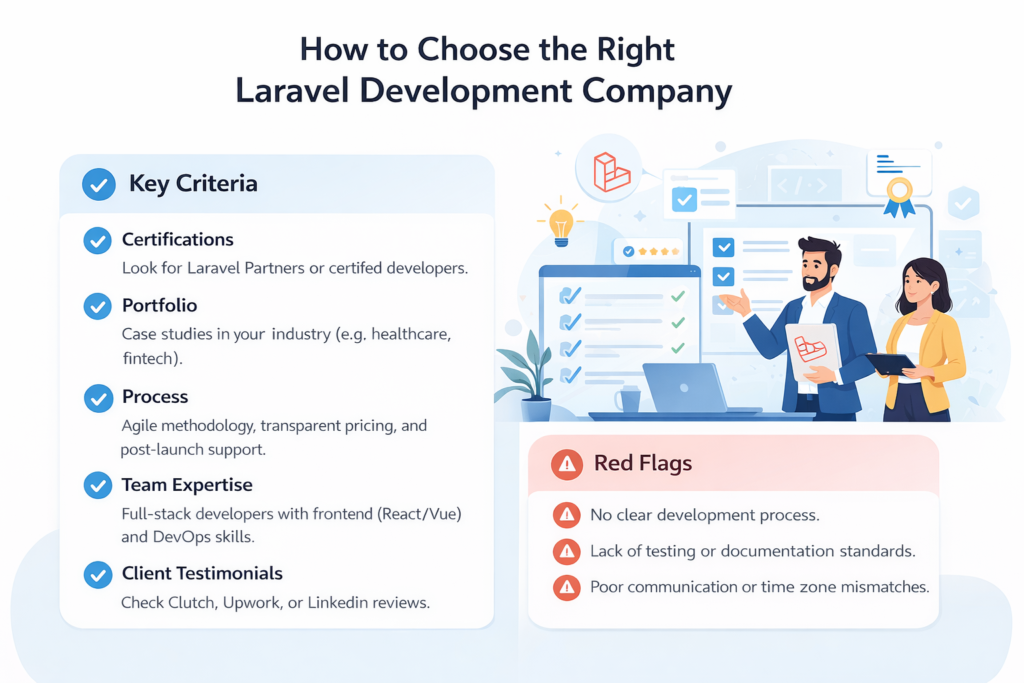
How to Choose the Right Laravel Development Company
Key Criteria:
- Certifications: Look for Laravel Partners or certified developers.
- Portfolio: Case studies in your industry (e.g., healthcare, fintech).
- Process: Agile methodology, transparent pricing, and post-launch support.
- Team Expertise: Full-stack developers with frontend (React/Vue) and DevOps skills.
- Client Testimonials: Check Clutch, Upwork, or LinkedIn reviews.
Red Flags:
- No clear development process.
- Lack of testing or documentation standards.
- Poor communication or time zone mismatches.
Is Laravel Suitable for Startups, SaaS, and Enterprise Projects?
Laravel’s versatility extends across organizations of all sizes and stages. Understanding how Laravel serves different organizational contexts helps in making informed technology decisions.
Laravel for Startups
Rapid Development is crucial for startups that need to validate ideas quickly and iterate based on market feedback. Laravel’s expressive syntax, extensive package ecosystem, and built-in features for common requirements allow small teams to build functional products rapidly. This speed-to-market can be the difference between capturing an opportunity and missing it.
Cost Efficiency matters for resource-constrained startups. Laravel’s open-source nature eliminates licensing costs. The abundance of Laravel developers means competitive rates for outsourced development. The framework’s efficiency means fewer developer hours required to achieve functionality compared to less productive frameworks.
Scalability for Growth ensures that initial technical choices don’t become constraints. Startups that find product-market fit often experience rapid growth, and Laravel applications can scale to handle this growth without requiring complete rebuilds.
Investor Confidence can be influenced by technology choices. Laravel’s popularity and proven track record at scale reassure investors that the technology isn’t a risk factor. The framework’s maintainability means that technical due diligence won’t reveal concerning technical debt or unsustainable architecture.
Laravel for SaaS Applications
Multi-tenancy Support is essential for SaaS applications serving multiple customers from a single codebase. While not built into the Laravel core, the ecosystem includes robust packages for implementing multi-tenant architectures. These solutions handle database separation, tenant identification, and resource isolation, allowing SaaS companies to focus on their unique value proposition rather than infrastructure concerns.
Subscription and Billing Integration is streamlined through Laravel Cashier, which provides elegant interfaces to Stripe and Paddle for subscription management. This integration handles the complexity of subscription billing, including proration, invoicing, and payment method management, accelerating SaaS development.
API-First Architecture is natural in Laravel, supporting the API requirements that modern SaaS applications need. Whether serving web frontends, mobile applications, or third-party integrations, Laravel’s API capabilities, including authentication, rate limiting, and resource transformation, provide the foundation for SaaS platforms.
White-Label and Customization Capabilities serve SaaS companies targeting enterprise customers who require customization. Laravel’s modular architecture, configuration management, and theming capabilities support white-label deployments and customer-specific customizations without maintaining separate codebases.
Laravel for Enterprise Projects
Enterprise Security Requirements are met through Laravel’s comprehensive security features. The framework’s CSRF protection, SQL injection prevention, XSS protection, and encryption capabilities address common security requirements.
Integration with Enterprise Systems is facilitated by Laravel’s flexibility. The framework integrates with LDAP and Active Directory for authentication, connects to enterprise databases and message queues, and supports the SOAP and REST APIs that enterprise systems typically expose. This integration capability allows Laravel applications to fit into existing enterprise architectures rather than requiring wholesale replacement.
Maintainability and Long-term Support are critical for enterprise applications that may remain in service for a decade or more. Laravel’s commitment to backward compatibility (LTS releases receive bug fixes for two years and security fixes for three), comprehensive documentation, and large developer community ensure that applications can be maintained and enhanced long-term.
Team Scalability is supported by Laravel’s clear conventions and architecture. Large development teams can work on Laravel applications without stepping on each other’s work, thanks to the framework’s modular structure, clear separation of concerns, and established patterns.
Making the Right Choice
Laravel serves all three contexts effectively, but implementation approaches differ. Startups might prioritize speed and iterate rapidly, accepting some technical debt that gets refactored later. SaaS companies invest more upfront in architecture for multi-tenancy and scalability. Enterprise projects emphasize documentation, testing, and integration capabilities. The key is matching Laravel’s capabilities to your specific context and engaging developers who understand the particular challenges of your organizational stage and industry.
What Comes After Launch? Maintaining and Scaling a Laravel Application
- The launch is just the beginning. A successful application requires a lifecycle management strategy.
- Security Patches: The Laravel team releases security updates regularly. A maintenance plan ensures your application is updated immediately to close vulnerabilities.
- Performance Tuning: As user data grows, database queries that were fast during launch may slow down. Regular optimization and indexing are required.
- Dependency Management: Laravel applications rely on packages. Regular updates of these packages via Composer are necessary to prevent compatibility issues.
- Scaling Strategies: As traffic grows, your team should implement load balancing, database read replicas, and CDN integration to maintain performance.
Conclusion
Our Laravel development services combine scalable architecture, enterprise security, and cloud-native deployment strategies to help businesses build high-performance applications that grow with demand.
Laravel development services in 2026 remain the strategic choice for businesses seeking custom Laravel web development, enterprise scalability, API-driven architecture, and long-term digital growth.
Build Smarter with Laravel
Looking to develop a fast, secure, and scalable web application?
Our team specializes in crafting custom Laravel solutions, whether it’s a startup MVP, SaaS platform, or enterprise system. We focus on performance, clean code, and long-term scalability.
👉 Let’s discuss your Laravel project today and explore the best approach for your business.
Have questions? Drop a comment or contact us directly
We’re happy to help.
Frequently Asked Questions About Laravel Development Services
1. What Are Professional Laravel Development Services?
Laravel development services refer to the professional creation, customization, and maintenance of web applications using the Laravel framework. These services include backend development, API integration, database management, UI/UX design, and deployment. Businesses hire Laravel developers to build scalable, secure, and high-performance web applications tailored to their needs.
2. Why Should Businesses Choose Laravel Development Services in 2026?
In 2026, many businesses chose Laravel development services. They want to build products fast. They also need strong security. They prefer an API-first approach. They want cloud apps that can scale. They also want lower maintenance costs over time. Laravel’s ecosystem (Forge, Vapor, Nova) also enables faster deployment and infrastructure management.
3. Is Laravel Suitable for Startups?
Yes! Laravel is an excellent choice for startups.
4. Can Laravel Handle High-Traffic Applications?
Absolutely. Laravel is designed to handle millions of users with features.
5. What Types of Applications Can Be Built with Laravel?
Laravel is versatile and can be used to build:
- SaaS platforms (e.g., project management tools)
- E-commerce applications (e.g., custom online stores)
- CRM/ERP systems (e.g., sales and inventory management)
- Healthcare applications (HIPAA-compliant solutions)
- FinTech applications (secure payment gateways)
- Real-time applications (e.g., chat apps or live dashboards)
6. How Do I Choose the Right Laravel Development Company?
Look for certified Laravel experts with real experience, client reviews, agile workflows, and full-stack skills (Laravel + React/Vue).
7. Is Laravel Good for Enterprise Applications?
Yes, Laravel offers scalability, security (CSRF/SQL protection), and modular architecture, making it ideal for enterprise-grade applications.
8. What Is the Typical Laravel Development Process?
It includes planning, agile development, testing, deployment (Forge/Vapor), and maintenance for seamless, high-quality delivery.
9. How Do Laravel Development Services Ensure Security?
Laravel provides built-in CSRF protection, SQL injection prevention, bcrypt hashing, and OAuth, ensuring robust security for applications.
10. What Frontend Technologies Work Best with Laravel?
React, Vue.js, Next.js, and Livewire integrate seamlessly with Laravel for dynamic, high-performance frontend experiences.

![Flutter UI Design: Create Beautiful Mobile App Interfaces [2026]](https://blog.binary-fusion.com/wp-content/uploads/2026/02/featured-flutter-ui-design-guide-1.png)
![Laravel + React: The Complete Guide for Business Owners and Beginners [2026]](https://blog.binary-fusion.com/wp-content/uploads/2026/02/Gemini_Generated_Image_665qn8665qn8665q.png)